
How GRAVHOUNDS progression works: milestones, Research Points, blueprints and the lab loop that makes every extraction count.
GRAVHOUNDS Progression Guide: Milestones and Research
GRAVHOUNDS is an extraction game, which means the run is temporary and the lab is permanent. Everything that survives a run — blueprints, Research Points, unlocked weapons, turrets and hounds — is fed by the loop you repeat. Understanding that loop is more valuable than any single build, because it tells you which runs are worth taking.
This guide explains the milestone engine, how Research Points convert into power, what carries over, and the pacing that avoids the two classic mistakes: grinding easy planets forever and dying on hard ones for nothing.
Official source: GRAVHOUNDS Early Access FAQ ↗ — Early Access will add more Gravhounds, jobs, worlds, enemies, weapons, upgrades and progression.
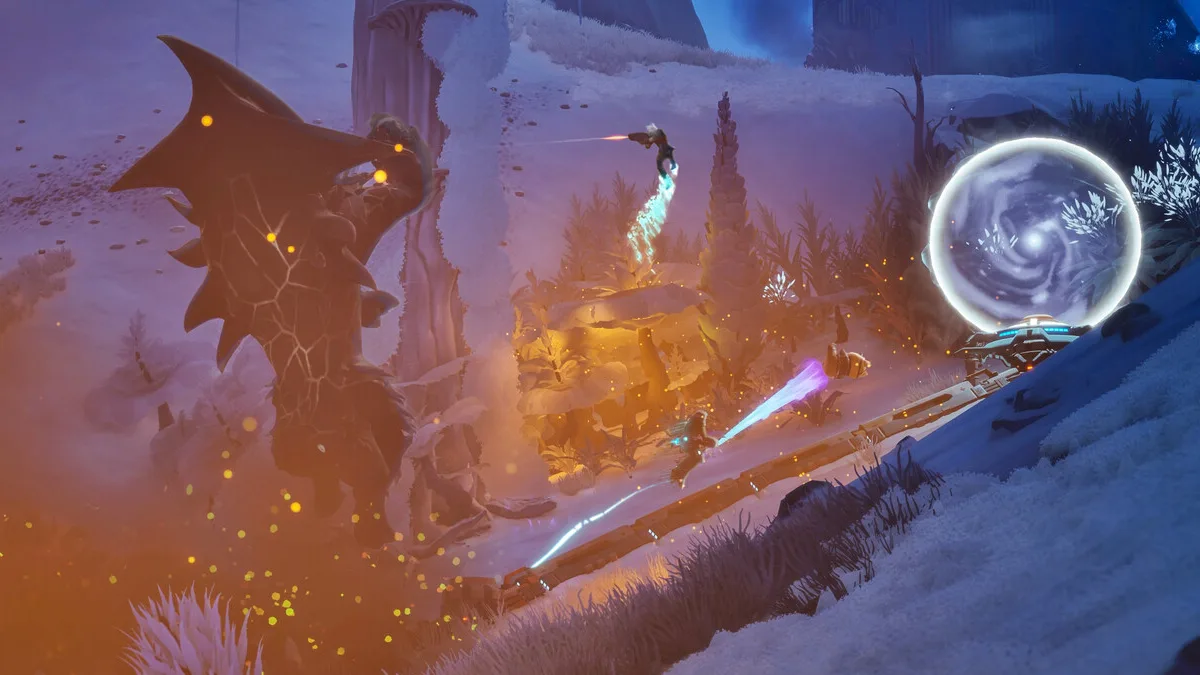
The two tracks
| Track | Lifetime | Fed by | Spent on |
|---|---|---|---|
| Run | One drop | Resources, pods, mods | Turrets, base, temporary power |
| Lab | Permanent | Milestones, blueprints, extracted resources | Weapons, turrets, mods, hounds |
The run track is where the action is. The lab track is where the progress is. A player who only thinks about the run will plateau; a player who understands the lab will keep getting stronger even on failed runs.
Milestones: the engine
Milestones are the objectives that generate Research Points. They are not kill counters. They are completed actions: finish an objective, extract with a blueprint, survive a wave tier, complete a planet.
Three consequences:
- Completed runs beat deep runs. A twelve-minute extraction with two objectives is worth more than a thirty-minute run that dies at the collector.
- Objectives are the priority. The resource you mine is secondary to the objective you finish.
- Variety is efficient. Different planets and objective types feed different milestones, so rotating planets is not just for fun.
If you want to progress faster, stop optimizing damage and start optimizing completion rate.
Research Points: where they go
RP buys permanent upgrades in the lab. The categories are:
- Weapons — new platforms and upgrades.
- Turrets — new deployables and tiers.
- Mods — the deck pool.
- Utility — power, movement, survival.
The upgrade path has the full priority order. The short version: second weapon, core turrets, generator efficiency, mod breadth, then everything else.
Do not spread RP evenly. The lab rewards depth in a few categories far more than a point in every category, because a build only needs one strong axis to work.
Blueprints: the permanent unlocks
Blueprints are found on planets and extracted. They unlock turrets, weapons and mods permanently. The Star Map shows how many blueprints remain on each planet, which turns hunting into a checklist rather than a guess.
Blueprint discipline:
- Extract after the blueprint. The blueprint is permanent; the rest of the backpack is not.
- One planet per hunting run. Route optimization beats speed.
- Do not chase a blueprint into a losing wave. A blueprint you die holding is not unlocked.
- Prioritize blueprints for gear you already use. An upgrade to your main turret beats a new toy.
The efficient loop
The loop that progresses fastest looks like this:
- Pick a planet you can clear. Not the hardest one you can survive — the one you can finish.
- Take one or two objectives. Enough milestones to make the run worth it.
- Hunt one blueprint if the planet has one. Otherwise mine the near ring.
- Extract before the swarm tier outgrows the base. Minute ten to fourteen is the usual window.
- Spend RP before the next run. A banked upgrade is wasted time.
- Rotate planets. Variety feeds milestones and prevents burnout.
This loop is boring on purpose. It is the fastest path to the interesting part of the game, which is having enough options to build whatever you want.
Pacing: when to push
Push to a harder planet when:
- You extract clean twice in a row.
- Your base survives a full wave without you standing in it.
- You have a build that does not depend on a lucky pod.
- You have at least one survival answer (Finn, movement mods, or a second generator).
Do not push because you are bored. Boredom is the most expensive reason to lose a run.
What carries over, exactly
Carries over:
- Research Points and lab upgrades.
- Blueprints.
- Unlocked weapons, turrets, mods and hounds.
- Extracted resources that fund upgrades.
Does not carry over:
- Mods taken during a run.
- Turrets and structures built on a planet.
- Resources left behind.
- Demo progress.
The distinction matters because it tells you what to protect. On a run, protect the blueprint and the extraction. Everything else is replaceable.
Early Access and the roadmap
GRAVHOUNDS launched into Early Access on November 2, 2026. The developers expect the period to last around six months, possibly longer, with more Gravhounds, jobs, worlds, enemies, weapons, upgrades and progression before 1.0. Prices are expected to rise during Early Access.
That means the progression system you are learning now is a foundation, not a final form. Builds will change, tiers will shift, and new hounds will re-rank the roster. The roadmap guide tracks what is confirmed and what is speculation.
Two clean twelve-minute runs beat one thirty-minute run that dies. The lab rewards frequency, not endurance.
Common progression mistakes
- Farming the starter planet forever. Comfortable, and the slowest possible path.
- Dying on red planets for a blueprint you cannot extract. Zero progress, high cost.
- Hoarding RP. Spend it; there is no interest rate.
- Ignoring milestones for kills. Kills are not the engine.
- Unlocking breadth before depth. Ten weak options are worse than three strong ones.
FAQ
What is the main progression currency? Research Points from milestones.
Do I lose progress when I die? Lab progress is permanent; run loot is lost.
How do I unlock new hounds? Through milestone progression. The character unlock guide covers it.
How long is Early Access? Around six months, possibly longer, per the developers.
What should I do first? Finish the tutorial, extract twice from the starter system, and spend RP on a second weapon.
Further reading
Summary
Finish runs, take objectives, extract blueprints, spend RP, rotate planets. The lab is the only thing that lasts. The upgrade path tells you what to buy; the walkthrough tells you where to go.
More GRAVHOUNDS Guides
Build a GRAVHOUNDS base that survives escalating swarms: site selection, four defensive layers, power placement and layouts for solo to four players.
A first-shift walkthrough for GRAVHOUNDS: what to mine, where to build, how pipes pay for themselves, and when to call the ship.
A complete GRAVHOUNDS build for hard planets: rapid-fire crit weapon, turret support deck, Dozer mines and the exact 10-card Mod Deck.
The best GRAVHOUNDS character for solo, duo, four-player packs and boss runs, with the reasoning and the loadout each hound enables.
A practical GRAVHOUNDS Juggernaut guide: arena preparation, phase behavior, turret placement, team roles and the mistakes that wipe the base.
How GRAVHOUNDS builds work: the 10-card Mod Deck, Showstoppers, weapon choices and the stack rules that decide whether a run snowballs.